
This article will guide you through the available options, including eSIM plans for Internet and information about voice calling, to help you stay connected easily and affordably.
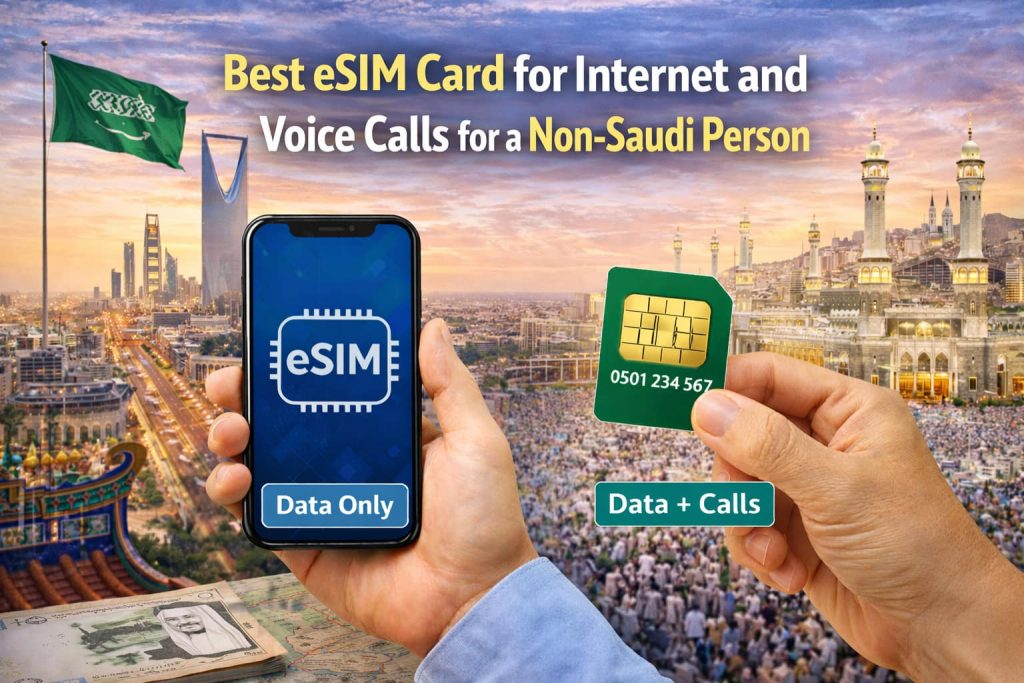
I. What Is an eSIM and Why It’s Useful for Non-Saudi Travelers
An eSIM (embedded SIM) is a digital version of a SIM card that allows you to activate a mobile data plan online—without inserting a physical SIM. Travelers can purchase and install it before arriving in Saudi Arabia using just a phone and a QR code.
Why Non-Saudis Prefer eSIMs:
- Quick setup before or after you arrive in Saudi Arabia
- No need to visit a store or show your passport
- No physical SIM swap needed—you can keep your home SIM active
- Flexible data plans for short or long stays
- Avoids expensive international roaming fees
You can find prepaid eSIM plans starting from as low as $5 at [https://saudiarabiaesim.com/], a trusted service designed for international tourists.
II. Options for Mobile Connectivity in Saudi Arabia
When choosing how to connect your phone, most non-Saudi visitors consider four main options:
- eSIM for travelers
- Local physical SIM card
- International roaming
- Public Wi-Fi
Let’s look at each closely.
III. eSIM for Internet Access
An eSIM is the easiest way to stay online as soon as you land. You simply buy it online, receive a QR code by email, and activate it on your phone.
Advantages
- Instant delivery and activation process
- Data connection available on arrival
- Accessible pricing across multiple plans
- 4G LTE coverage across Saudi Arabia
- Can use hotspots or data sharing on most phones
Limitations
- Data-only plans; no traditional local number for calls or SMS
- Requires an unlocked, eSIM-compatible smartphone
Typical Plans from [SaudiArabiaESIM.com]:
- 7-day plan: from $6.50 (1GB–10GB)
- 15-day plan: from $7.90 (2GB–15GB)
- 30-day plan: from $8.50 (3GB–20GB)
After purchase, you get your eSIM instantly via email and can connect as soon as you arrive.
IV. What About Voice Calls?
Most eSIMs for tourists in Saudi Arabia are data-only, meaning you cannot make or receive normal phone calls or SMS using a Saudi number. However, there are simple ways to communicate:
- Use Internet-Based Apps: Use WhatsApp, Telegram, FaceTime, Skype, or Zoom for voice and video calls. Note: WhatsApp messaging works fine in Saudi Arabia, but WhatsApp voice and video calls may not function properly because VoIP services are restricted in the country.
- Keep Your Primary SIM Active for Calls: You can use your eSIM for data and your home SIM for receiving calls or texts (for example, 2FA messages from banks). Remember to disable international roaming for calls if you want to avoid charges.
- Voice Apps with Local Numbers: If you truly need a Saudi number, you can buy a local prepaid SIM from mobile carriers like STC, Mobily, or Zain, which includes local numbers for calling.
V. Local SIM Cards for Tourists
You can also buy a prepaid SIM at airports or stores after arriving.
Advantages
- Includes local number for calls and SMS
- Works on any unlocked phone
- Reasonable local rates for data and talk time
Disadvantages
- Requires passport registration
- Activation may take extra time
- Not instantly available before your trip
Local SIM cards are more suitable for long-term stays or those who frequently need to make local calls.
VI. International Roaming and Wi-Fi Alternatives
Roaming: Using your home SIM in Saudi Arabia can be convenient, but it usually costs between $5 and $15 per day, making it the most expensive option for long stays.
Public Wi-Fi: Available in airports, hotels, and restaurants, but often slow and unreliable. It should be used as a backup, not the main Internet source.
VII. Device Compatibility for eSIMs
Not all phones support eSIM technology. Make sure your phone is both carrier-unlocked and listed as eSIM compatible.
Common compatible devices include:
- iPhone XR and newer models (up to iPhone 17 Pro Max)
- Samsung Galaxy S20 and newer
- Google Pixel 4 and newer
- Huawei, Xiaomi, and OPPO flagship devices
A complete list of eligible devices is available on the “eSIM Supported List” page at [https://saudiarabiaesim.com/].
VIII. Comparison: eSIM vs SIM vs Roaming
| Feature | eSIM | Physical SIM | Roaming |
| Setup | Online (QR code) | In-person | Automatic |
| Activation Time | Instant | 10–15 minutes | Instant |
| Voice/SMS | Data only | Yes | Yes |
| Internet Speed | 4G LTE | 4G LTE | Varies |
| Cost | From $5 | From $3 | $5–15/day |
| Best For | Tourists, short trips | Long stays | Emergencies |
IX. Recommendations for Non-Saudi Travelers
For most visitors:
- If you need fast Internet and convenience, get an eSIM.
- If you need a local Saudi number for calls, buy a local prepaid SIM from STC, Mobily, or Zain.
- Avoid roaming except for short trips or emergencies.
- Use Wi-Fi to reduce data use, but don’t rely on it for consistency.
Combining both solutions works best: Keep your home SIM for essential calls, and use an eSIM for data from [https://saudiarabiaesim.com/]. This gives you reliable 4G connectivity, instant setup, and full control over your budget.
X. Final Thoughts
For non-Saudi visitors, the eSIM is currently the most practical choice for Internet connectivity. It offers complete flexibility without the paperwork or registration required by physical SIM cards.
If you also need to make voice calls, simply use VoIP apps or combine your home SIM for incoming calls with a Saudi travel eSIM for data.
Before you travel, check your device compatibility and find the right plan for your stay at [https://saudiarabiaesim.com/].